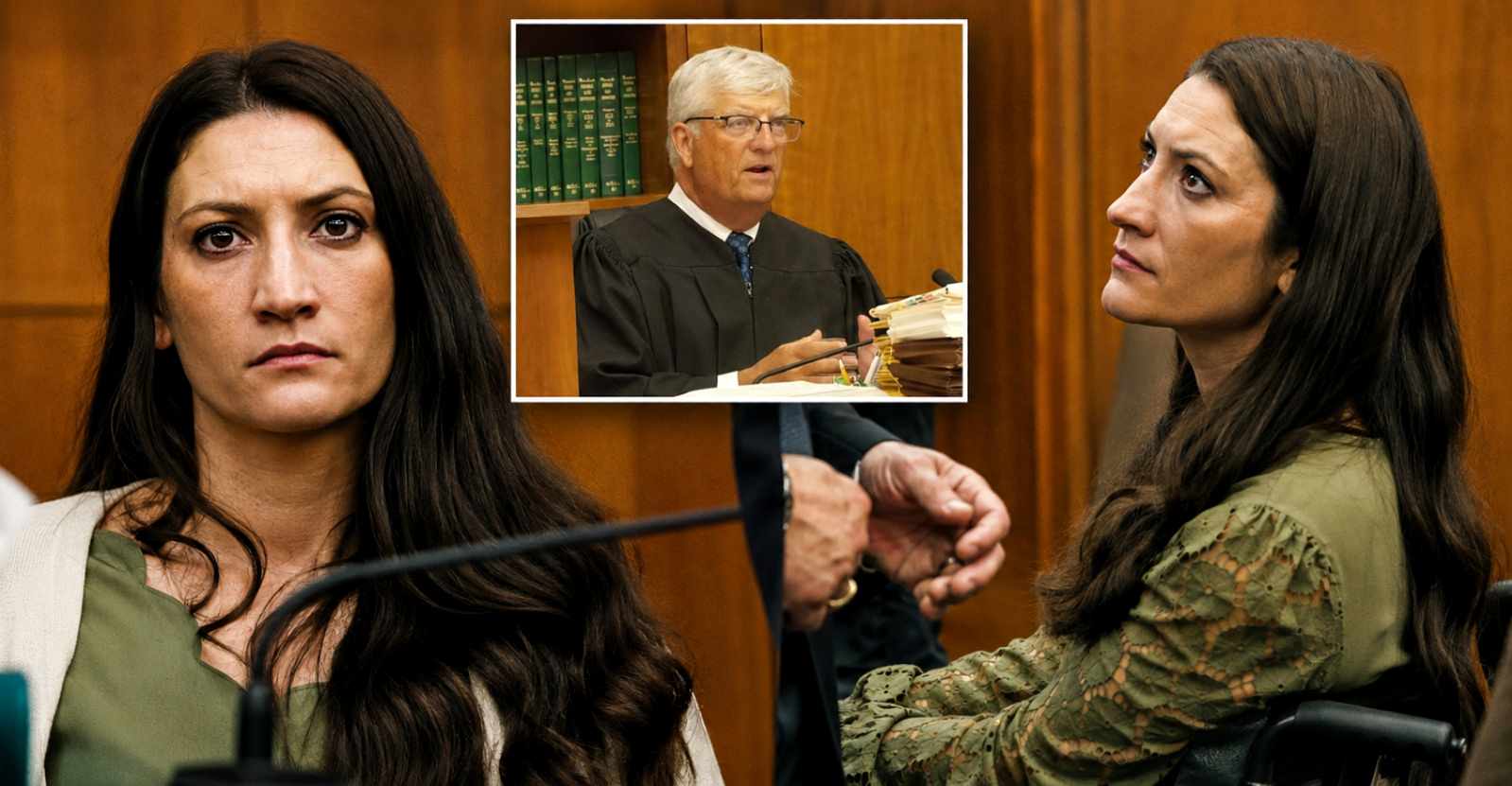
The murder trial of Lindsay Clancy, the Massachusetts mother charged with strangling her three young children to death in their Duxbury home, continued Thursday with limited testimony before the jury was sent home early for the second straight day.
Supporters in pink shirts gathered outside both Tewksbury State Hospital, where Clancy is being held, and the courthouse, as her defense team pressed claims that postpartum psychosis rendered her not criminally responsible for the January 2023 killings of 5-year-old Cora, 3-year-old Dawson, and 8-month-old Callan.
Defense attorney Kevin Reddington, entering the Plymouth Superior Court, remarked on his client’s condition: “She’s so beat up, and so sad, so this will really help her out, I think.”
The sole witness called Thursday was Sheila Cavanaugh, a chaplain at Brigham and Women’s Hospital who visited Clancy roughly 14 times after the killings and Clancy’s subsequent plunge from a second-story window that left her partially paralyzed.
Cavanaugh described first encountering the defendant on January 25, 2023, when Clancy could not speak.
“She was dressed in medical armor. She had tubes. She was intubated. She had bandages. She had a neck brace. She was just covered and layered in equipment that allowed her to breathe,” Cavanaugh said.
Cavanaugh testified she vividly recalled the first words Clancy uttered once the breathing tubes were removed.
“She said to me, as I held her hand to comfort her, ‘I am so glad my children are safe,’” Cavanaugh said. “I replied theologically to Lindsay, and I said, ‘Lindsay, your children are safe. They are safe in Heaven with God.’”
The chaplain further stated that Clancy referenced hearing a persistent male voice. “She alluded to having heard a voice.
And the voice, according to Lindsay, told her that if she did not follow the command, neither she nor her children would not be safe,” Cavanaugh said, adding that discussions of “the voice” arose multiple times during those hospital visits.
Prosecutors quickly challenged the reliability of that account during cross-examination.
Prosecutor Shanan Buckingham noted Cavanaugh’s meticulous written records of the meetings.
“You wrote very detailed notes,” Buckingham said.
“Yes, I did,” Cavanaugh replied.
“And you never once wrote about the voice, correct?”
Buckingham pressed.
“Correct,” Cavanaugh answered.
The exchange underscored a recurring theme in the trial: defense experts and witnesses describing auditory commands and mental collapse after the fact, while contemporaneous medical documentation often lacks those specific details.
Clancy has pleaded not guilty to three counts of murder.
Her attorneys acknowledge she caused the children’s deaths but argue she lacked criminal responsibility due to severe postpartum psychosis, a condition they claim left her unable to appreciate the wrongfulness of her actions or conform her conduct to the law.
On Wednesday, forensic psychologist Dr. Paul Zeizel, who met with Clancy dozens of times after the incident, concluded his testimony by affirming the defense’s central claim.
Under questioning from Reddington, Zeizel agreed that Clancy had lost substantial capacity to appreciate the wrongfulness of her conduct or to conform to the requirements of the law because of mental illness.
Reddington asked about records from January 7, 2023—two weeks before the killings—regarding intrusive thoughts.
“Did she have, at this point, intrusive thoughts continuing regarding voices in her head that she heard constantly?” Reddington asked. “Yes,” Zeizel said.
“What were these voices saying to her?” Reddington followed. “They were getting worse, and they were telling her to kill herself,” Zeizel replied.
Yet under cross-examination, Buckingham highlighted the absence of such reports in the actual clinical records from September 2022 through late January 2023.
“My question to you, though, was where in the records from September to Jan. 23 or Jan. 22 did she tell any of the providers she saw that she heard a voice telling her to kill herself?” Buckingham asked. “It’s not in the records,” Zeizel acknowledged.
Buckingham further asked how many times Clancy had reported currently hearing voices in the years since the killings.
“She has not heard voices since the event took place in 2023,” Zeizel said.
Prosecutors also reviewed hospital notes from Tewksbury State Hospital marking the anniversaries of the children’s deaths and their birthdays, pointing out that staff recorded no unusual behavioral health issues on those emotionally charged dates.
Earlier in the defense case, former medical examiner Dr. Elizabeth Laposata detailed the injuries Clancy sustained in the fall from the window, including spinal damage and cutting injuries, in an apparent effort to rebut any suggestion that the suicide attempt was less severe than claimed.
Dr. Donald Condie reviewed outpatient records and described symptoms consistent with postpartum depression, including anxiety and brain fog.
Advertisement
Clancy’s former mother-in-law, Susan Clancy, a longtime labor and delivery nurse, described her as “very nurturing, very loving” and “a wonderful mother” who “loved her children, all of them, very, very much,” while noting Lindsay had sought help for sadness and insomnia in late 2022.
Judge William Sullivan has managed a trial marked by procedural interruptions, including an “unforeseen circumstance” that ended proceedings early Wednesday and the blocking of a potential defense witness located via TikTok.
The jury was again excused Thursday after Cavanaugh’s brief appearance, with the judge indicating Friday would bring a fuller day of testimony as the defense nears the close of its case.
For many following the proceedings, the central question remains whether claims of auditory hallucinations and psychosis—emerging most vividly after the fact—should absolve a parent of responsibility for the deliberate strangulation of three defenseless children.
The prosecution continues to probe inconsistencies between post-incident statements and the contemporaneous medical record, while the defense insists the evidence shows a mother overwhelmed by untreated mental illness.